J. L. BELL is a Massachusetts writer who specializes in (among other things) the start of the American Revolution in and around Boston. He is particularly interested in the experiences of children in 1765-75. He has published scholarly papers and popular articles for both children and adults. He was consultant for an episode of History Detectives, and contributed to a display at Minute Man National Historic Park.

Subscribe thru Follow.it


•••••••••••••••••


Showing posts with label Dr. Cotton Tufts. Show all posts

Monday, June 22, 2026

“Orders to march to Breeds Hill in Charlestown”

As I quoted yesterday, in July 1775 the Massachusetts Provincial Congress officially deemed the provincial fortification of Breed’s Hill in Charlestown to have been done “by some Mistake.”

Nine months later, Dr. Cotton Tufts echoed that assessment in a letter to John Adams: “Could a greater Blunder have been committed than that of Breeds Hill. Yet it finally has operated to our Advantage and trust will continue to do so.”

By then, New Englanders had decided that the Battle of Bunker Hill had worked out well because, even though they’d suffered hundreds of casualties and lost territory, the cost for the British army was catastrophic.

Who had made that fateful mistake? The report used the passive voice to avoid naming names, but everyone knew the battlefield commanders who’d overseen the building of the redoubt were Col. William Prescott, Connecticut general Israel Putnam, and Massachusetts colonel Richard Gridley of the artillery.

And the rumor I quoted here absolved Gridley, saying one of the top two infantry officers had insisted on Breed’s Hill. Or, to be exact, either Prescott or Putnam had insisted on digging the redoubt there before fortifying a fallback position on Bunker’s Hill, as the other two men thought wise.

Adams followed up the report from Massachusetts with some questions from Philadelphia. On 25 August, Prescott wrote back: “On the 16 June in the Evening I received Orders to march to Breeds Hill in Charlestown. . . . We arrived at the Spot, the Lines were drawn by the Enginier and we began the Intrenchmant…”

No written orders survive. If Gen. Artemas Ward and his council of war did indeed use the name “Breed’s Hill,” that would be our earliest confirmed example of that label, before the newspapers accounts I quoted here. But it’s also possible Prescott wrote “Breed’s Hill” in hindsight to reflect his understanding of those orders.

Prescott’s letter criticized some other officers. Gridley “the Enginier forsook me.” His “Field Officers being indisposed could render me but Little Service.” That makes it notable that Prescott didn’t complain about Putnam overruling his judgment and insisting on fortifying Breed’s Hill first. It thus seems clear that Prescott had been the officer sticking to that course.

Prescott didn’t take that position (figuratively and literally) because he deemed it more strategic for attacking Boston, as some analysts have argued. He declared that he was following instructions from his superiors. Perhaps those orders included some ambiguous term like “Charlestown Hill.” The memory of such a command probably empowered Prescott to convince Gridley to draw the entrenchment lines despite his and Putnam’s concerns—because that’s what they understood the council of war had told them to do.

TOMORROW: Why that mattered.

Tuesday, May 27, 2025

“Surely the most ridiculous expedition that ever was plan’d”

After the exchange of fire over Grape Island on 21 May 1775, both sides of the war claimed to have damaged the other and gotten the best of the day.

Four days after the fighting, the New-England Chronicle stated:
Whether any of the Enemy were wounded, is uncertain, though it is reported three of them were. It is thought that they did not carry off more than one or two tons of hay.
As for the gunfire from the departing Royal Navy vessels, that was “without effect.”

The next day’s Connecticut Gazette was even more positive:
the People…wounded 3 of the Enemy, and drove them off. They had got a Ton and Half of Hay on Board.
And the 3 June Pennsylvania Ledger said:
the regulars returned to Boston, with the loss of eight men killed and several wounded, as the provincials were informed by a gentleman that left Boston the next day.
In contrast, Lt. John Barker of His Majesty’s 4th Regiment wrote in his diary that ”a few of the Rebels were killed, without any loss on our side,” and he estimated the amount of hay removed as up to “7 or 8 Tons.”

Militaries always have a better sense of their own losses and usually exaggerate the enemy’s. If we follow that guideline and accept only what each army said about its own force, then the day ended without any casualties on either side.

The Crown forces had taken away a few tons of needed hay, but the Patriots burned far more—even Barker guessed his comrades had left “about 70” tons behind.

The provincials also burned Elisha Leavitt’s barn on the island. Local tradition held that he treated his neighbors to rum during the day to avert similar violence against his property on shore.

As usual, Lt. Barker saw a lot to complain about:
It was surely the most ridiculous expedition that ever was plan’d, for there were not a tenth part boats enough even if there had been Men enough, and the Sloop which carried the Party mounted 12 guns, but they were taken out to make room, whereas if one of two had been left it would have effectually kept off the Rebels
That might have been echoed in the 26 May Connecticut Gazette: “We hear Gen. [Thomas] Gage blamed the Admiral [Samuel Graves] for sending Vessels that were so small, on this Enterprize.” We should ask how the printers could reliably know such a thing. On the other hand, it may be significant that Graves skipped over this action in his self-serving report narrative of the war.

The reaction on the provincial side was very different. In a follow-up letter to her husband, Abigail Adams had nothing but praise for the locals who took part in the fight, particularly their own relatives:
I may say with truth all Weymouth Braintree Hingham who were able to bear Arms, and hundreds from other Towns within 20 30 and 40 miles of Weymouth.

Our good Friend the Doctor [Cotton Tufts] is in a very misirable state of Health, has the jaundice to a [very gr]eat degree, is a mere Skelliton and hardly able to [ride fro]m his own house to my fathers. Danger you [know] sometimes makes timid men bold. He stood that day very well, and generously attended with drink, Bisquit, flints &c. 5 hundred men without taking any pay. He has since been chosen one of the committee of Correspondence for that Town, and has done much Service by establishing a regular method of alarm from Town to Town.

Both your Brothers were there—your younger Brother [Elihu Adams] with his company who gaind honour by their good order that Day. He was one of the first to venture aboard a Schooner to land upon the Island.
That reflects the general mood on the two sides at this time. The British military was having inter-service quarrels over logistics while the provincials were celebrating solidarity. Even though neither side had accomplished a great deal, or suffered a serious loss.

Sunday, May 25, 2025

“3 Sloops and one cutter had come out”

In May 1775, the people of Hingham and other towns along the South Shore from Boston weren’t really worrying about protecting livestock on harbor islands.

As a 3 May petition from selectmen in Braintree, Weymouth, and Hingham to the Massachusetts Provincial Congress put it, those towns felt “in great danger of an attack from the troops now in Boston, or from the ships in the harbor.”

They worried that the British military would attack the towns themselves, not off-shore pasturage—perhaps to seize food but mostly to punish the rebellious population.

The congress therefore authorized those towns to raise two and a half companies of men for their defense through the end of the year, on the same terms as the provincial soldiers being signed up to keep besieging Boston. In Hingham, James Lincoln took a captain’s commission and started recruiting.

On the morning of Sunday, 21 May, vessels were spotted maneuvering through the islands off the Weymouth shore. Abigail Adams described the response in north Braintree:
When I rose about six oclock I was told that the Drums had been some time beating and that 3 allarm Guns were fired, that Weymouth Bell had been ringing, and Mr. [Ezra] Welds [churchbell in Braintree’s middle precinct] was then ringing.

I immediatly sent of an express to know the occasion, and found the whole Town in confusion. 3 Sloops and one cutter had come out, and droped anchor just below Great Hill. It was difficult to tell their design, some supposed they were comeing to Germantown others to Weymouth. People women children from the Iron Works flocking down this Way—every woman and child above or from below my Fathers.

My Fathers family flying, the Drs. [Cotton Tufts’s] in great distress, as you may well immagine for my Aunt had her Bed thrown into a cart, into which she got herself, and orderd the boy to drive her of to Bridgwater which he did. The report was to them, that 300 hundred had landed, and were upon their march into Town.

The allarm flew [like] lightning, and men from all parts came flocking down till 2000 were collected
In Scituate, Paul Litchfield was home from Harvard College, his senior year cut short by the war. He wrote in his diary:
Just before meeting began in morning, hearing the King’s troops were landing near Hingham, the people in general dispersed, so no meeting.
The 25 May New England Chronicle, newly moved to Cambridge, reported this military response:
Last Sabbath about 10 o’clock A.M. an express arrived at General [John] Thomas’s quarters at Roxbury, informing him that four sloops (two of them armed) were sailed from Boston, to the south short of the bay, and that a number of soldiers were landing at Weymouth.

Gen. Thomas ordered three companies to march to the support of the inhabitants.
But the first newspaper report of the action was the 22 May Newport Mercury:
An express arrived here this morning, from Providence, with advice, that a party of soldiers from Boston had landed at Weymouth, and burnt the town down, and were ravaging the country when the express came away. Troops from all parts of the country were going to oppose them.——The particulars not yet come to hand.
TOMORROW: The particulars of what really happened.

Sunday, May 12, 2024

“A small shock of an Earthquake” in 1783

Last fall the Heidelberg Center for American Studies shared Katrin Kleemann’s remarks about an earthquake that rattled a lot of the northern U.S. of A. in late 1783.

Kleemann wrote:
Many of the diaries I studied in the American archives mentioned this earthquake—in Philadelphia, New Haven, Boston, and Worcester. Most of these entries are really brief, usually only consisting of a few words, such as the line “Between 10 & 11 [pm] a small shock of an Earthquake” from Cotton Tufts’ diary on 29 November 1783. He lived in Weymouth, Massachusetts. The fact that diarists from several different states reported on the earthquake, means the earthquake must have been felt over a large area and must in fact have been quite strong, but not strong enough to cause widespread destruction.

Several contemporary newspapers also featured reports about this earthquake, such as this one above in the Pennsylvania Packet and General Advertiser, published in Philadelphia, from 2 December 1783:
“On Saturday night last, about a quarter after ten o’clock, a smart shock of an earthquake was felt in and about this city; and about one o’clock on Sunday morning another, less violent, was felt by many people in the city and suburbs. Most of the houses were very sensibly shaken so that in many the china and pewter, &c. were thrown off the shelves, and several persons were waked [sic] from their sleep. We hope that the country has sustained no damage by this convulsion of nature, which brings fresh to our memory the late calamities of Italy, &c, &c.”
Indeed, the earthquake(s) seemed to have awoken many people along the East Coast…
Kleemann’s primary focus is on climate events. I’ve noted her interesting essays in past postings. Last year she published A Mist Connection: An Environmental History of the Laki Eruption of 1783 and Its Legacy.

TOMORROW: The local angle.

Friday, July 17, 2020

“I have removed H——n out of the house”

As I quoted yesterday, in July 1775 John Adams sent his wife Abigail confirmation in writing that their tenant hand, an “old Man” named Hayden, should move out of the rooms he occupied in one of their Braintree houses.

Hayden had refused Abigail’s request, saying her husband would never have asked that of him. But that was just a delaying tactic.

John was still in Philadelphia for the Second Continental Congress on 21 October when Abigail updated him on the effect of his letter:
Hayden does not stir. Says he will not go out of the parish [i.e., north Braintree, now Quincy] unless he is carried out—and here nobody will let him come in. I have offerd him part of the House that [a neighbor named] Field is in if he will but go out, but no where suits, and it is not to be wonderd at as he has wood at free cost and has plunderd pretty well from the family they live [with] many articles. I have a great mind to send a sheriff and put him out.
But she didn’t. For one thing, Abigail still needed men to work the farm, and the war made labor even more expensive.

Finally on 9 Apr 1778 Abigail Adams could write to her sons’ tutor, John Thaxter:
There is no reformation with regard to prices here, tho money grows scarcer, Labour is much more exorbitant than it was when you left us. The most indifferent Farmer is not to be procured under 10 and 12 pounds per month.

I know you will give me joy when I tell you that I have wrought almost a miracle. I have removed H——n out of the house, or rather hired him to remove and have put in a couple of Industerous young Fellows, to whom I let the Farm to the Halves.
In a letter to John that month, Abigail went into more detail about the new arrangements:
Many domestick affairs I wish to consult upon. I have studied for a method of defraying the necessary expences of my family. In no one Instance is a hundred pound L M better than thirteen pounds Six and Eight pence used to be, in foreign Articles no ways eaquel, in taxes but a fourth part as good. Day Labour at 24 shillings per day. What then can you think my situation must be?

I will tell you after much embaresment in endeavouring to procure faithfull hands I concluded to put out the Farm and reduce my family as much as posible. I sit about removeing the Tenants from the House, which with much difficulty I effected, but not till I had paid a Quarters Rent in an other House for them. I then with the kind assistance of Dr. [Cotton] T[uft]s procured two young Men Brothers newly married and placed them as Tenants to the halves retaining in my own Hands only one Horse and two Cows with pasturage for my Horse in summer, and Q[uinc]y medow for fodder in winter
Abigail had paid old Hayden’s rent for his first three months somewhere else—anywhere else.

I’ve quoted at extra length from those 1778 letters to show how Abigail Adams became more explicit about prices and economic trends over the course of the war. Eventually she was managing the Adams family’s finances, reporting to John on investments but no longer asking him for permission in advance.

Monday, June 29, 2020

Perspectives on Boston’s 1764 Smallpox Epidemic

On 13 Apr 1764, John Adams sent his fiancée Abigail a story about being inoculated against smallpox in Boston.

Through a cousin of Abigail’s, Dr. Cotton Tufts, Adams and his brother had received a referral to Dr. Nathaniel Perkins. At first Perkins responded that he wasn’t taking any new patients, however, and that the brothers should have prepared with medications before coming into town. When Adams wrote again, dropping Tufts’s name, that changed things:
The Dr. came, immediately with Dr. [Joseph] Warren, in a Chaise—And after an Apology,…for not recollecting what Dr. Tufts had told him, Dr. Perkins demanded my left Arm and Dr. Warren my Brothers.

They took their Launcetts and with their Points divided the skin for about a Quarter of an Inch and just suffering the Blood to appear, buried a Thread about a Quarter of an Inch long in the Channell. A little Lint was then laid over the scratch and a Piece of a Ragg pressed on, and then a Bandage bound over all—my Coat and waistcoat put on, and I was bid to go where and do what I pleased. (Dont you think the Dr. has a good Deal of Confidence in my Discretion, thus to leave me to it?)

The Doctors have left us Pills red and black to take Night and Morning. But they looked very sagaciously and importantly at us, and ordered my Brother, larger Doses than me, on Account of the Difference in our Constitutions.
This was the first time Adams met Warren, whom he described as “a pretty, tall, Genteel, fair faced young Gentleman.” Warren was still only twenty-two years old. Eventually he would become an Adams family physician, political colleague, and friend. As a doctor barely out of training, Warren didn’t lead Boston’s fight against smallpox in 1764, but that was the first public health crisis he faced and thus a milestone in his medical career.

The Dr. Joseph Warren Historical Society was founded recently by Randy Flood, an interpreter at the American Revolution Museum at Yorktown. Randy’s using the current pandemic to explore the 1764 smallpox outbreak through a series of online interviews, which you can watch here. So far he and Christian Di Spigna, author the Warren biography Founding Martyr, have talked to:

Thursday, September 19, 2019

“Perswaded that Charles did not deserve the suspicions”

The Harvard College Thanksgiving banquet in November 1787 ended badly. By the evening, window glass and wooden benches were lying on the ground outside the hall. That might have had something to do with how every student had brought a bottle of wine.

The Harvard faculty levied a ten-shilling fine on each student who had gone to that dinner and couldn’t prove he'd left before the destruction started. The administration then relented in the case of the sophomores, but not the seniors or juniors—including Charles Adams, class of 1789.

The fines went out in the quarterly bills at the start of 1788. So there was no way Charles could keep the bad news from his family (as he would try to do with financial reverses in the late 1790s).

At the time, Charles’s parents, John and Abigail, were still on a diplomatic mission in Britain. The task of looking after their sons had fallen to relatives: Abigail’s older sister Mary Cranch in Braintree; her younger sister Elizabeth Shaw and her husband John in Haverhill; and John’s cousin Dr. Cotton Tufts of Medford, who managed the family money.

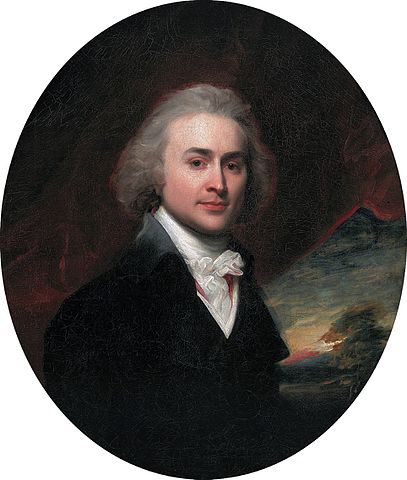
Eldest son John Quincy Adams (shown above) had graduated from Harvard the year before and gone to Newburyport to study law. On breaks he got together with both younger brothers. On 2 Feb 1788, after one such visit, John Q. wrote in his diary:

I had with Mr. Shaw some conversation upon the subject of the disorders which happened at College, in the course of the last quarter: his fears for my brothers are greater than mine: I am perswaded that Charles did not deserve the suspicions which were raised against him: and I have great hopes that his future conduct, will convince the governors of the University, that he was innocent.
The Rev. John Shaw had tutored both Charles and Thomas Boylston Adams to prepare them for college, as well as other boys. (Including Charles’s first roommate or “chum,” who’d gotten into worse trouble—but I’ll talk about that some other time.) Shaw was clearly worried about Charles’s behavior while John Q. tried to stand up for him.

Two weeks later John wrote to Dr. Tufts for some spending money, noting that he’d asked Charles to pass on the request but, well, “I am apprehensive he forgot to deliver my message.” Like many oldest sons, he seems to have felt both protective of his little brothers and convinced they were incurable idiots.

John Q. went on with more hopeful comments about the situation:
The riotous ungovernable spirit, which appeared among the students at the university in the course of the last quarter gave me great anxiety; particularly as I understood, that one of my brothers, was suspected of having been active in exciting disturbances; but from his own declarations and from the opinion I have of his disposition, I hope those suspicions, were without foundation—I conversed with him largely upon the subject, and hope, his conduct in future, will be such as to remove, every unfavourable impression.
Others in the family were adding their voices, perhaps less optimistically. The next day, 17 February, Aunt Elizabeth wrote to Aunt Mary:
I long to hear from Charles & Thomas I charged them to write to me— I do not know that Mr Shaw & I could have given them better advice if they had been our own Sons— I hope they will conduct agreeable to it—& be wiser than they have been, & more cautious of abusing Government, for what they from choice suffer—the Ten shillings penalty, I mean—
As I wrote a couple of days ago, I think the record shows that only Charles had been fined the ten shillings and Tommy still had a near-spotless record at college. But he was the little brother, and the family didn’t want Charles to lead him astray.

Unfortunately, all those admonitions didn’t keep Charles out of trouble in his senior year.

TOMORROW: A rough winter in Cambridge.

Thursday, July 28, 2011

A Matrimonial Story

On 30 Nov 1762, John Adams recorded an anecdote in his diary:
Last Thurdsday Night, at [Richard] Cranch’s Wedding, Dr. [Cotton] Tufts, in the Room where the Gentlemen were, said We used to have on these Occasions, some good Matrimonial stories, to raise our spirits. The story of B. Bicknal’s Wife is a very clever one. She said, when she was married she was very anxious, she feared, she trembled, she could not go to Bed. But she recollected she had put her Hand to the Plow and could not look back, so she mustered up her Spirits, committed her soul to G[od]. and her Body to B. Bicknal and into Bed she leaped and in the Morning she was amazed, she could not think for her Life what it was that had scared her so.
I’m guessing this tale—if true—involved Mary Bicknell, born Mary Kingman in 1729. She married Benjamin Bicknell, Jr., of Weymouth in 1747, had four children with him, and died in 1766. Unlike about a quarter of New England women marrying for the first time in this century, Mary Bicknell did not have a child within seven months of her marriage, so her wedding night, when she was only seventeen, could well have been her first time lying with a man.

Of course, if the story had circulated long enough, the woman could have been Benjamin’s mother, born Susanna Humphrey in Weymouth in 1695 and married in 1717. She, too, had four children, and outlived her daughter-in-law, dying in 1767. The elder Benjamin Bicknell then remarried the widow Bethiah Hunt, one of John Adams’s paternal aunts, showing how these families were all part of the same circle.